

Is A Wifi Motherboard Worth It
When it comes to WiFi on computers, yous have 3 very common options: Onboard Wi-Fi, PCIe WiFi Card and a USB WiFi dongle. They all have their respective pros and cons.
For instance, the obvious benefit of onboard WiFi is that it saves an extra PCIe slot on your motherboard. Similarly, PCIe WiFi Cards are peachy as they give you the option to supercede or uninstall them in the future, and USB WiFi bill of fare are just cheap and accessible for an boilerplate user.
But the real question is, how do they differ in terms of their operation? Here we will compare Wi-Fi vs Wi-Fi Card vs Wi-Fi USB both in their characteristics and performance.
Onboard Wi-Fi vs Wi-Fi Card vs Wi-Fi USB
What is Onboard Wi-Fi?
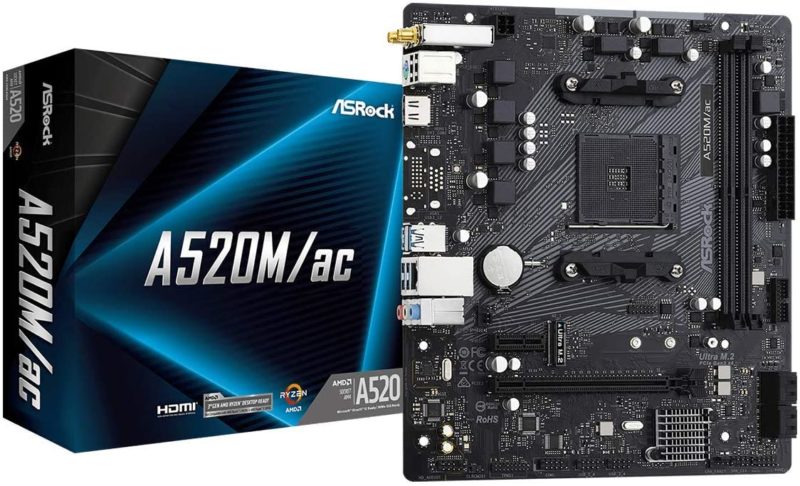
An onboard WiFi basically means that the motherboard has a WiFi modem built in.
This is perhaps simplest way to build a desktop where you absolutely need a WiFi connectedness. However, onboard WiFi is supported merely in sure motherboards.
Desktop motherboards with inbuilt motherboards are non quite common particularly in the budget and in the mid range – to an extent.
Also Read: Practice Motherboards Come with WiFi?
Pros of Onboard Wi-Fi
Eliminates The Toll of Purchasing Extra Components
For users who admittedly need WiFi, a motherboard with onboard Wi-Fi capability pre-installed volition eliminate the cost of purchasing an actress component.
Not bad for Certain Builds and Motherboard Form Factors
With onboard Wi-Fi, people without access to cablevision networks can access their networks immediately subsequently finishing their builds.
They are more, in a sense, streamlined and optimized.
Another important do good is that an on-board WiFi saves y'all from utilizing your precious PCIe slots. This is particularly of import on motherboard that have limited PCIe slots such as on a Mini ITX motherboard.
Cons of Onboard Wi-Fi
No Operation Difference to be Expected
Compared to a PCIe WiFi Card, there isn't whatsoever visible functioning difference between onboard or a PCIe WiFi Card.
The actual departure is made by the version of the WiFi, its frequency range, channel bandwidth, access scheme etc. (We comprehend this in the FAQ section beneath)
Hinders Upgradability
One meaning disadvantage of having an onboard WiFi is that information technology hinders upgradability of the WiFi network.
In that location may be faster options for accessing Wi-Fi in the future with greater range, higher speeds and lower latency.
With onboard Wi-Fi, upgrading the built in WiFi is not a possible option and you lot will finish upwards having to settle for the speeds that are provided by your board's onboard Wi-Fi adapter.
For example, if your motherboard comes with WiFi five card, y'all will not exist able to upgrade it to the newer WiFi 6.
Marginally More than Expensive than Non-WiFi Version
Additionally, all things considered, a motherboard with onboard Wi-Fi is more expensive compared to ane without information technology. There are exceptions though.
This might be something that users who don't actually need WiFi on their desktop would have to consider.
May Have to Sacrifice on a Certain Feature
If a motherboard features an onbaord WiFi, it may come up at a toll of another subcomponent. This is considering, the corporeality of PCIe lanes a system has are limited.
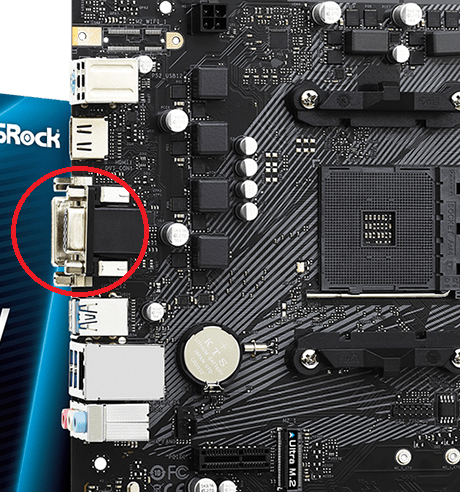
For instance, the ASRock A520M/Air conditioning (WiFi) does not feature the VGA port whereas the ASRock A520M-HDV (Non WiFi) does.
What is a Wi-Fi Carte?
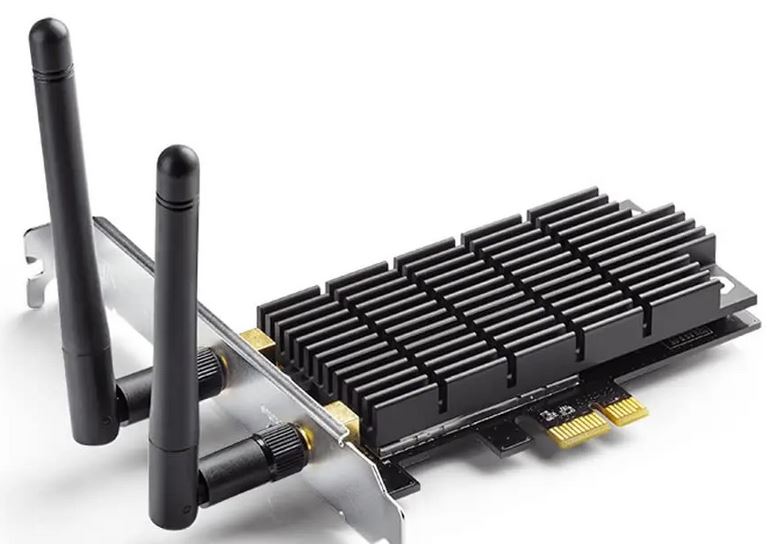
A Wi-Fi card is a loftier-speed PCIe device that adds Wi-Fi support for a motherboard by connecting to one of its PCIe slots.
Wi-Fi cards themselves are relatively affordable, but compared to USB WiFi, they can be a little more expensive. However, for users with a PCIe slot to spare, this maybe the best selection for fast wireless connections.
Also Read: Which PCIe Slot for Wireless Card?
Pros of Wi-Fi Card
High Speed Connecitivty
It offers high speed stable wireless connections. This is great for activities like online gaming.
The latest PCIe WiFi 6 cards have an average of 2.4 Gbps max transfer speed at 5 GHz frequency and 574 Mbps on 2.iv GHz Frequency. This translates to nigh 300 MB/southward.
Since nigh of the newer devices do operate at 5 GHz frequency you can leverage the faster 2.four Gbps speeds.
Replaceable
Ane of the biggest reward here is that you can replace them with a newer menu. So if in the future WiFi 7 is introduced, you will exist able to supplant it easily.
You can also switch them over to some other PC when need be.
Stable Connection
Near PCIe WiFi cards make use of the multiple-input and multiple-output (MIMO) method using multiple antennas which basically allows the menu to transmit and receive multiple data signals at a time. This further allows for higher and stable transfer speeds.
Cons of Wi-Fi Bill of fare
Challenging to Install for Non Techies
Wi-Fi PCIe cards tin exist challenging to install for the novice user. They are likewise more expensive than USB Wi-Fi adapters so well-nigh users on a upkeep would opt for the latter instead.
Occupy Precious PCIe Slots
Another large disadvantage with WiFi card is that they occupy PCIe lanes and slots. If you do not have a PCIe slot available, they are of no skillful. Therefore, you need to make certain that you have both a free PCIe slot as well as a gratuitous PCIe lanes.
Tin can Cramp Up Space in the Chassis
Finally, a WiFi PCIe Carte du jour can be an outcome when you lot accept cramped up space within in the PC. In some instances, they can fifty-fifty block larger components like graphics bill of fare from beingness installed.
Not a Huge Difference in Latency Compared To a USB Dongle
Contrary to the pop notion, a USB three.0 WiFi performs as good every bit a PCIe network carte du jour in terms of latency. You can come across the results for this in this video.
The latency depends upon many other factors including the distance from the WiFi router and if at that place are any obstacles.
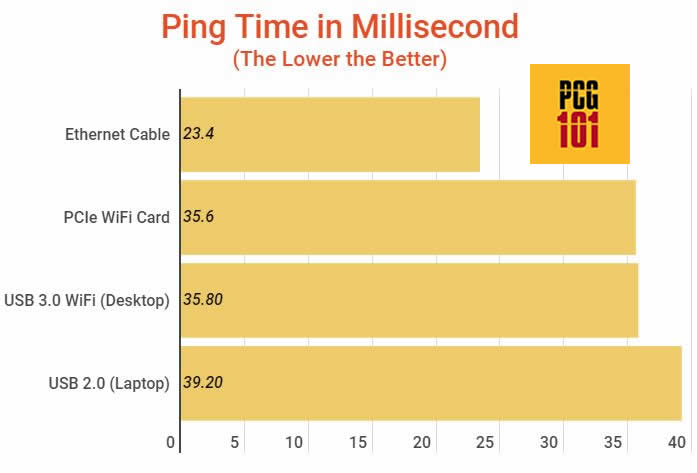
Hence, you tin see here that the departure in latency between PCIe WiFi Card and the USB 3.0 WiFi Carte isn't too drastic.
Of grade, the best latency would be provided by the hard wire ethernet cable.
What is Wi-Fi USB Adapter?
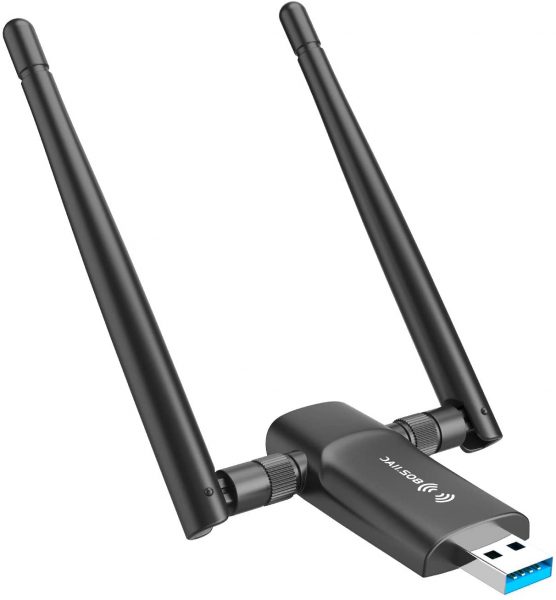
Unlike PCIe cards, these practise not go inside the case. They are plugged into a USB port.
These adapters are normally very affordable meaning that most users who want a decent or basic WiFican go for them.
Pros of Wi-Fi USB Adapter
Like shooting fish in a barrel to Install
They are very piece of cake to install. All you do is plug the device into an available USB slot and Voila! Drivers are installed and you're practiced to go.
You tin can get 1 with a USB extender that can assistance you vanquish WiFi dead spots in your workspace, allowing you to get the best signal coverage.
Y'all don't need to open upwards your instance, larn about PCIe lanes or about PCIe slots with these. They are small and meaty devices that exercise not occupy much space.
Since they are small you can literally comport them effectually with yous.
Affordable
As mentioned earlier, compared to USB WiFi Cards, they can exist much more affordable.
Cons of Wi-Fi USB Adapter
Weak Performance
Ane of the biggest advantage here is that they are weak in operation. They have weaker reception. Their transfer rate is much slower as compared to a congenital in menu and they are not as stable.
Every bit of still, USB WiFi dongles still operate at WiFi 5 protocol. Meaning they have max transfer speed of 867 Mbps as supposed to two.4 Gbps on WiFi 6.
The following compares a WiFi vi PCIe Menu (TP-Link AX3000) vs WiFi five USB Dongle (Foktech AC600).
TL;DR
- The WiFi 5 USB Dongles maintains download speed of 29 Mbps
- The WiFi 6 PCIe Card maintains download speed of 100 Mbps
- The Ping (latency) is the same on both
The USB version also has a lot of impact on the functioning of the WiFi dongle. USB 3.0 WiFi cards accept a better performance compared to USB 2.0 Cards.
USB 2.0 has transfer speed of 480 Mbps. However, this is just the theoretical max and the protocol never reaches this transfer speed. USB 3.0, on the other hand, has a speed of about 4.8 Gbps!
Therefore, a USB 3.0 would never bottleneck your USB WiFi transfer speeds (at least with the current generation of USB WiFi)
Prone to Harm and Unseating
Also, since they're exposed, yous could cease upwards unseating the adapter in the USB slot by accident, therefore, interrupting your network connection.
Besides Read: How to Connect Extra Fans to Motherboard?
Other FAQ
What is the Latest WiFi Protocol?
The latest WiFi iteration is the WiFi 6 or the 11AX. As is the case with each iteration, WiFi 6 improves on many aspects including the data transfer rate compared to the previous version.
The following is the chief difference in terms of specs:
[table "Wifi6comparison" non found /]
| WiFi 4 802.11n | WiFi v 802.11ac | WiFi 6 802.11ax | |
| Engagement Introduced | 2009 | 2013 | 2019 |
| Frequency Range | two.4 and 5 GHz | 5 GHz | 2.iv and 5 GHz |
| Channel Bandwidth (MHz) | twenty, 40 | twenty, 40, eighty, fourscore+lxxx, 160 | xx, 40, lxxx, 80+80, 160 |
| Quadrature Amplitude Modulation | 64-QAM | 256-QAM | 1024-QAM |
| Spatial Streams | 4 | 4 to viii | eight |
| MU-MIMO | No | Downlink | Uplink and Downlink |
| Access Scheme | OFDM | OFDM | OFDM and OFDMA |
Tabular array above extracted from the post-obit video. Recommended watch.
What is WiFi Frequency Range?
Frequency Range, aka Frequency Bands, are radio wave frequencies responsible for transmitting WiFi data.
There are two ranges: 2.4 and v.0 GHz. Both have pros and cons. 2.four GHz has an splendid coverage as it tin can penetrate through walls.
five.0 GHz, on the other manus promises higher speeds.
What is WiFi Channel Bandwidth?
This determines the connections transfer speed or the data rate. The higher the channel bandwidth, the higher the transfer speed.
What is is WiFi Quadrature Amplitude Modulation?
While this is a very technical subject area, the college the QAM, the faster is the data transfer rate.
The QAM-1024 on WiFi 6 can enable a 25% college data charge per unit as compared to WiFi v.
Recommended read regarding QAM: Wi-Fi 6 fundamentals: What is 1024-QAM?
What is MU-MIMO?
MU-MIMO stands for Multi-user, multiple-input, multiple-output technology. It essentially allows the "Wi-Fi router to communicate with multiple devices simultaneously" (Read: Linksys.com).
Hence, the devices exercise not take to expect for their turn, thus improving the efficiency of the WiFi connection.
The more devices you accept, the more benefit you will experience from a MU-MIMO supported WiFi router.
As well Read: Practice Motherboards Have Bluetooth?
Conclusion
Here we compared onboard Wi-Fi vs Wi-Fi card vs Wi-Fi USB. While the concluding say remains with you, each of these implementations has its own perfect applications.
An onboard adapter is great for those who desire to relieve themselves from the hassle of procuring separate WiFi cards.
A PCIe Wi-Fi card is splendid for users who want very stable connection and future upgradability.
A USB dongle tin be a great way to provide basic Wi-Fi to a motherboard that doesn't take onboard Wi-Fi. It's too ideal for moderate Wi-Fi users on a upkeep equally well equally for those who want the portable aspect of this method.
Source: https://pcguide101.com/motherboard/onboard-wi-fi-vs-wi-fi-card-vs-wi-fi-usb/
0 Response to "Is A Wifi Motherboard Worth It"
Post a Comment